Introducing The UWC ML Liaison Role
Machine-learning weather prediction (MLWP) is moving quickly. Global models such as AIFS, GraphCast, Pangu-Weather, Aurora, and others have made it clear that global resolution data-driven forecasting is no longer a distant research idea, and many operational centres have already made operational or in the process of developing regional (stretched-grid or limited-area) km-scale MLWP forecasting capabilities. However, the path towards something that is operationally useful, scientifically credible, and maintainable as part of a weather-service ecosystem is still being worked out.
That is the context for the UWC ML Liaison role.
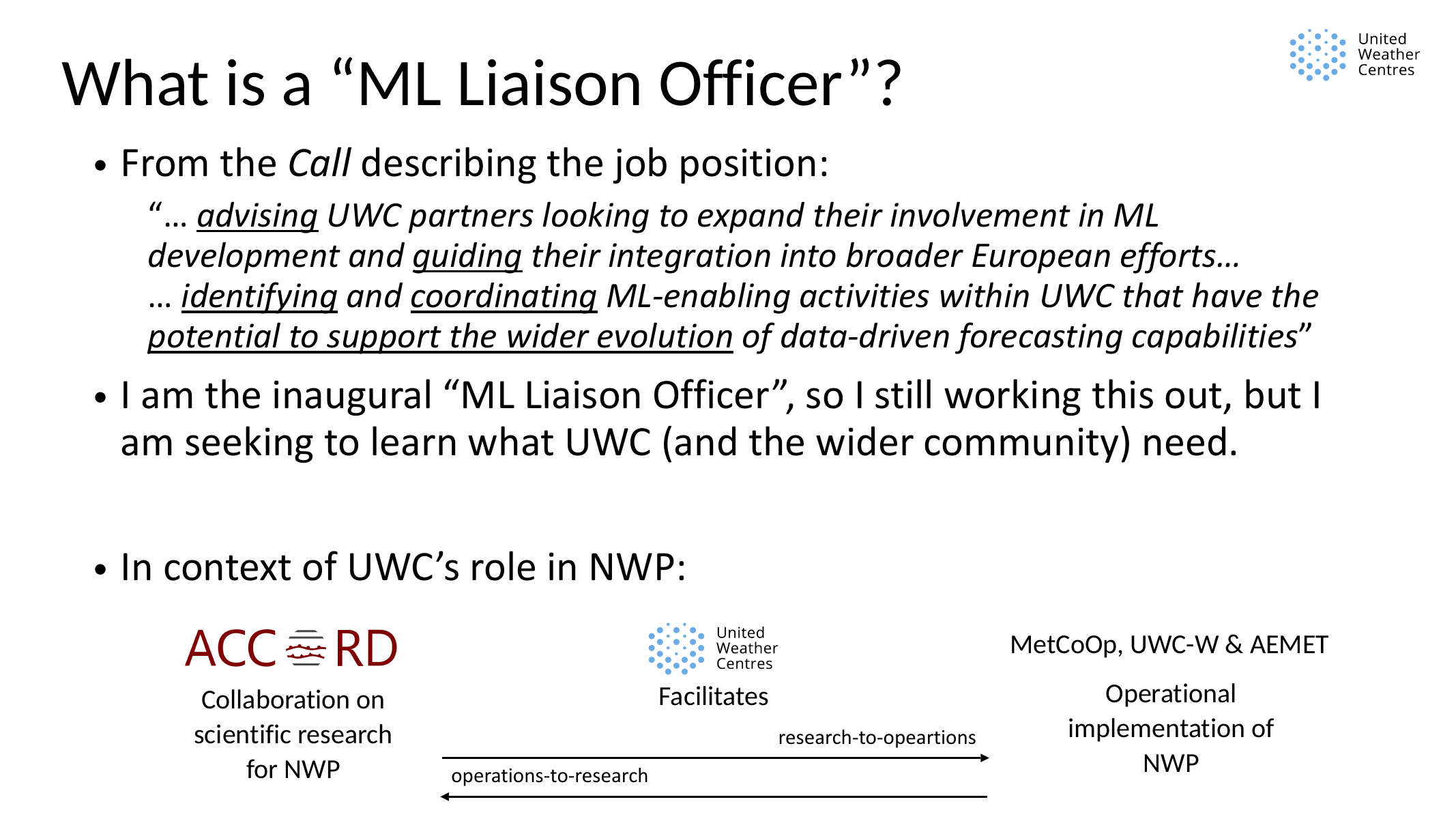
The UWC (United Weather Centers) is a collaboration between 11 European meteorological services, with the goal of sharing scientific development, operational modelling systems, and the exchange between research-to-operations and operations-to-research. The ML Liaison role is a new position within UWC, created to help coordinate the development and operationalisation of MLWP across the member services. And I am activitely contributing in the EUMETNET E-AI programme, and the ECMWF Machine Learning Pilot Project within it, to foster collobaration not just within UWC but also across the wider European weather and machine-learning community.
I am intending for this website to be a public working notebook for that role: a place to share what I am learning, what projects are moving, what questions are still open, and where I think collaboration around MLWP could be most useful.
So what is the ML Liaison role?
The formal call for the role described it as “advising UWC partners looking to expand their involvement in ML development, guiding their integration into broader European efforts, … and identifying and coordinating ML-enabling activities within UWC that could support the wider evolution of data-driven forecasting capabilities.”
That is a broad remit, and I am adjusting my focus based on feedback from the UWC members and the evolving landscape of MLWP. I am the first person in this role, so part of the work is still to discover what it should become in practice.
My interpretation is this: the ML Liaison should enable UWC members to make good collective decisions about machine-learning based weather forecasting to ensure we can fulfill our operational obligations. To me, that means helping the community understand the scientific frontier, build shared ways of evaluating models, and create practical routes for data-sharing, tooling, and co-development.
It is not only about following model scores. It is about asking what would make MLWP scientifically credible, operationally useful, and maintainable as part of a weather-service ecosystem.
Why cross-institutional coordination matters
Numerical weather prediction has always depended on a tight connection between scientific research and operational implementation. UWC exists in that tradition: collaborative scientific development, operational modelling systems, and the exchange between research-to-operations and operations-to-research.
MLWP changes the technical landscape, but it does not remove the need for that connection. If anything, it makes coordination more important, because many transitions are happening at once:
- from equation-based NWP towards data-driven or hybrid forecasting
- from separate analysis and forecast steps towards ML data assimilation or direct-from-observations forecasting
- from compute-intensive forecasts towards cheap inference and expensive training
- from GRIB-based forecast datasets towards Zarr and cloud-native data
- from scientific Fortran towards scientific Python
- from closed-source modelling systems towards open-source components
- from hand-coded software development towards more agent-assisted workflows
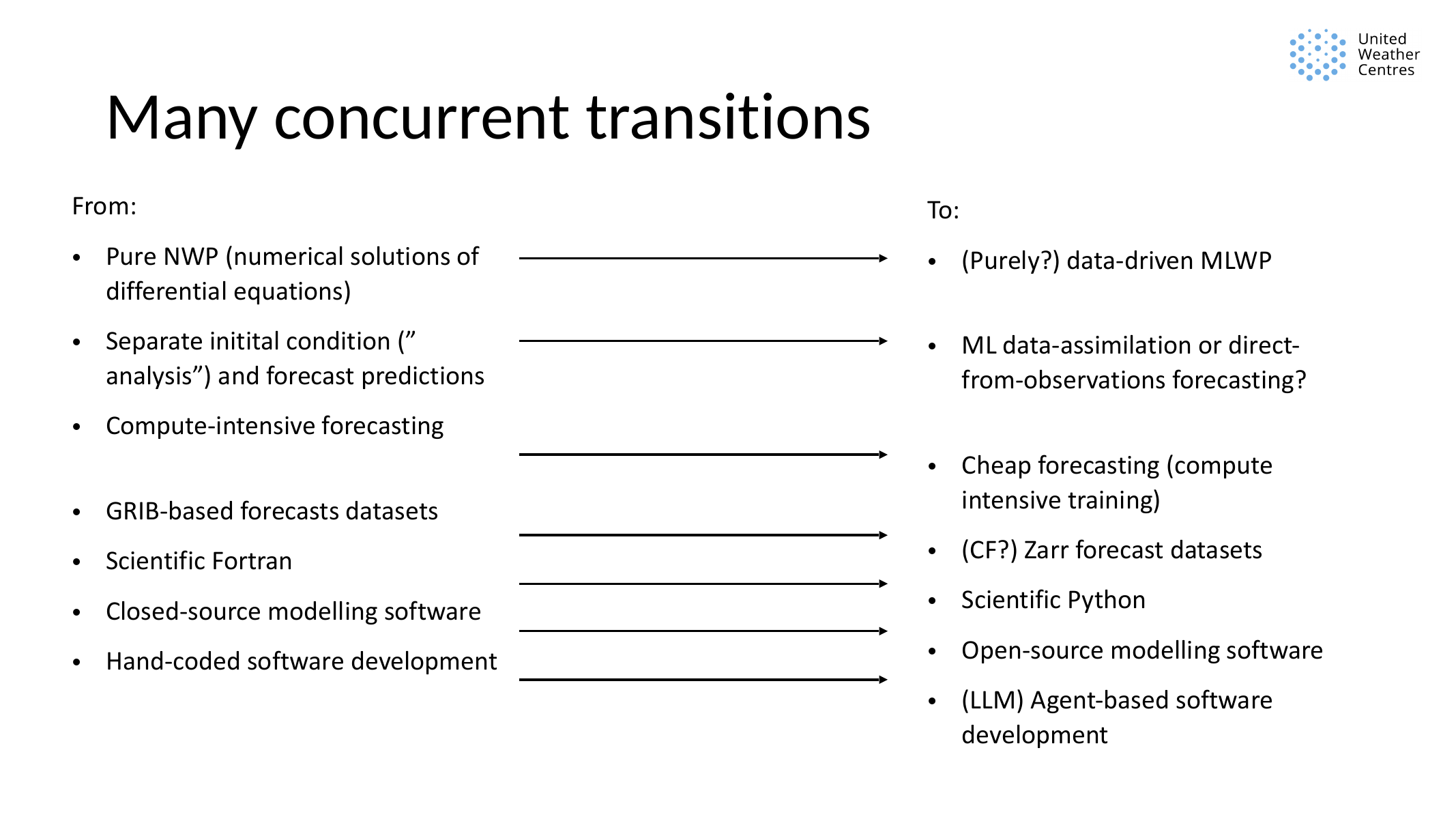
None of these transitions are isolated. Choices about data formats affect verification. Choices about software structure affect whether scientists can experiment. Choices about model architecture affect whether the model can be understood, diagnosed, and improved.
To the extent that I am able I want to facilitate that we make these transitions together.
What Operational MLWP Will Need
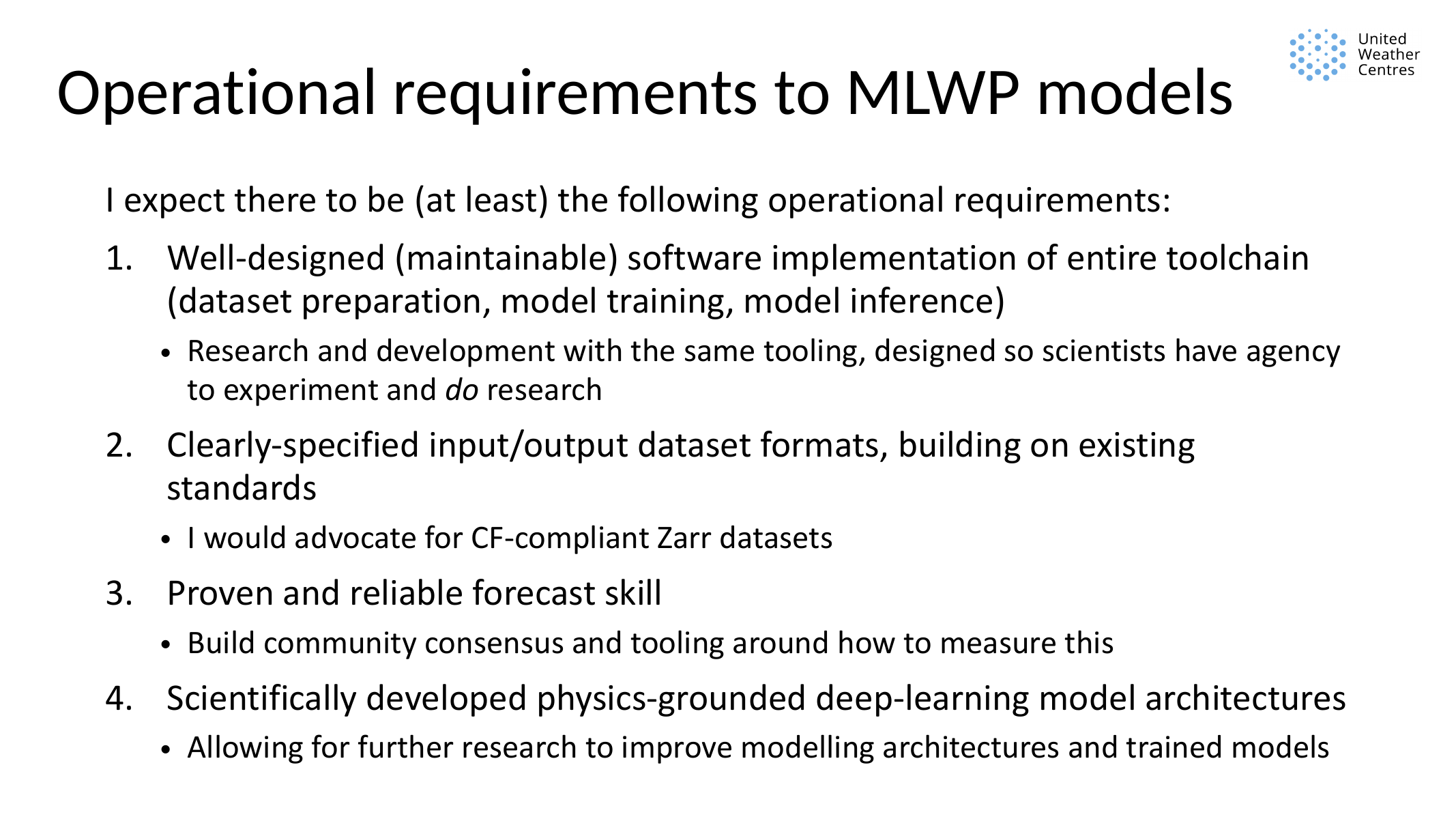
For MLWP to become operationally useful, I think at least four things matter:
The whole toolchain must be maintainable and generally applicable: dataset preparation, training, inference, evaluation, and downstream use. A good model checkpoint is not enough if the surrounding system cannot be understood, reproduced, or adapted. Research and development should use tooling that gives scientists agency to experiment. We do not yet know what the next useful ML architecture or training approach will be. If the toolchain is too rigid, it will block the research needed to improve it.
Input and output datasets need clear specifications. My current bias is towards CF-compliant Zarr datasets where possible, because we need forecast data that are easy to validate, share, inspect, and use across tools.
Forecast skill needs to be proven and reliable. That requires more than one centre running its own private evaluation. We need community consensus and reusable tooling around what should be measured and how.
Model development should remain grounded in weather physics. ML models are not magic. If they forecast the atmosphere well, they are learning something about atmospheric evolution. We should use physical and numerical understanding to ask when that learning is meaningful, when it fails, and what changes might make it better.
The Three Workstreams
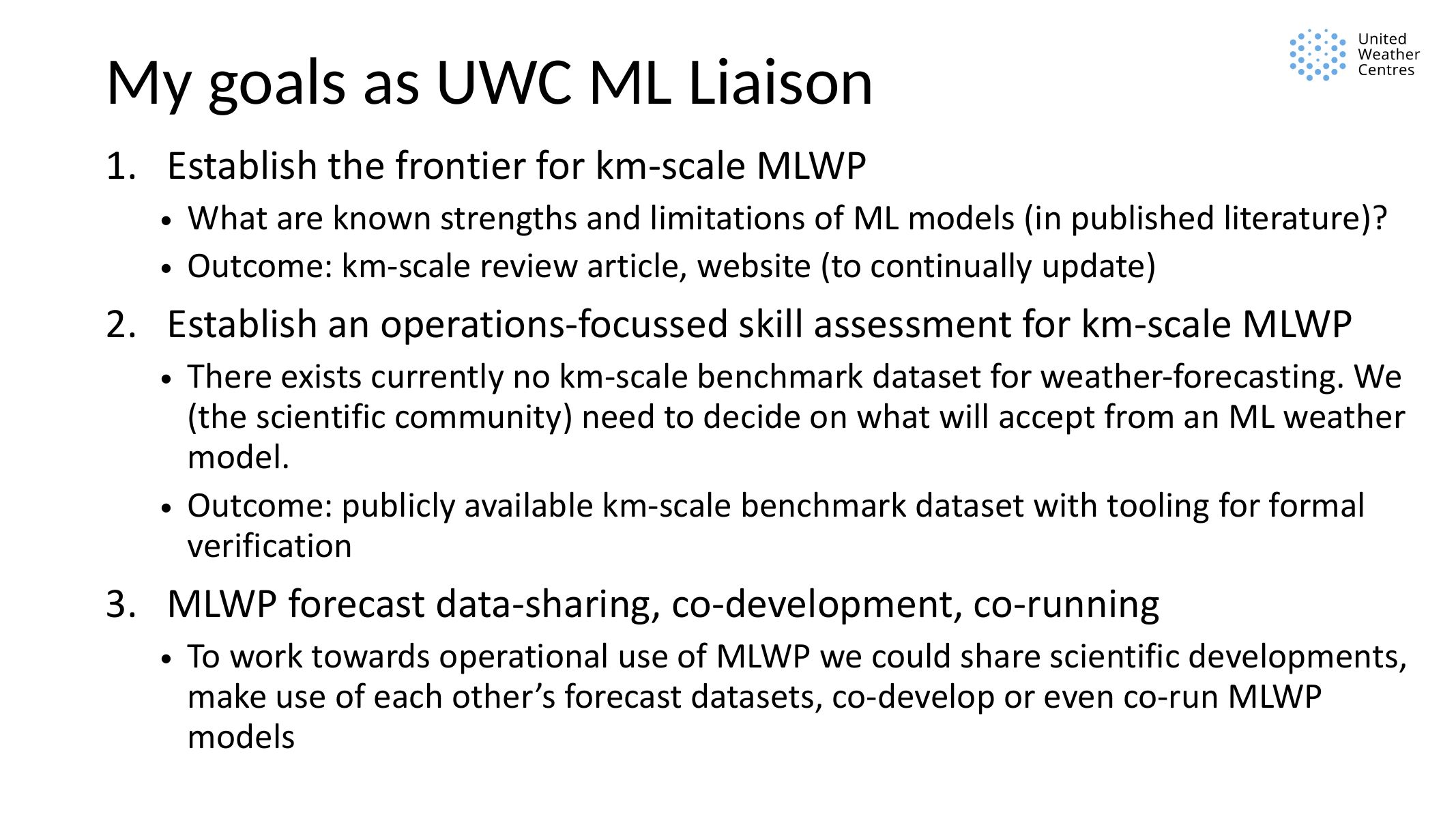
I currently organise my work around three connected goals.
1. Establish The Frontier For Km-Scale MLWP
The first goal is to understand what is known about kilometre-scale ML weather prediction from the published literature.
Which processes do current ML models represent well? Where do they fail? Are they physically consistent? Can they represent geostrophic balance, stability, convective rain, or cloud evolution? Can probabilistic or generative models produce physically meaningful spatial structures?
This work is linked to a review article and a continually updated publication overview at https://leifdenby.github.io/kmscale-pubs/ (please get in touch if you would like to contribute to the review article - everyone is welcome!).
(This is also linked to a physical processes MLWP seminar series I am organising, which will be announced in a future blog post.)
2. Establish Operations-Focused Skill Assessment
The second goal is to help establish an operations-focused way of assessing km-scale MLWP.
There is currently no widely accepted km-scale MLWP benchmark dataset for weather forecasting. More importantly, there is not yet a shared answer to what the community should accept from an ML weather model.
Pointwise scores are useful, but they are not enough. Operationally relevant assessment also needs to consider extremes, spatial structure, reliability, physical consistency, and behaviour in weather regimes that matter to forecasters.
The intended outcome is a publicly available benchmark dataset with tooling for formal verification.
3. Support Data-Sharing, Co-Development, And Co-Running
The third goal is to make practical collaboration easier.
If several meteorological services are generating MLWP forecasts, those forecasts should not all sit in separate formats and separate storage systems with separate bespoke tooling. A better route is shared forecast datasets, common format validation, and reusable tools for loading, displaying, and verifying forecasts.
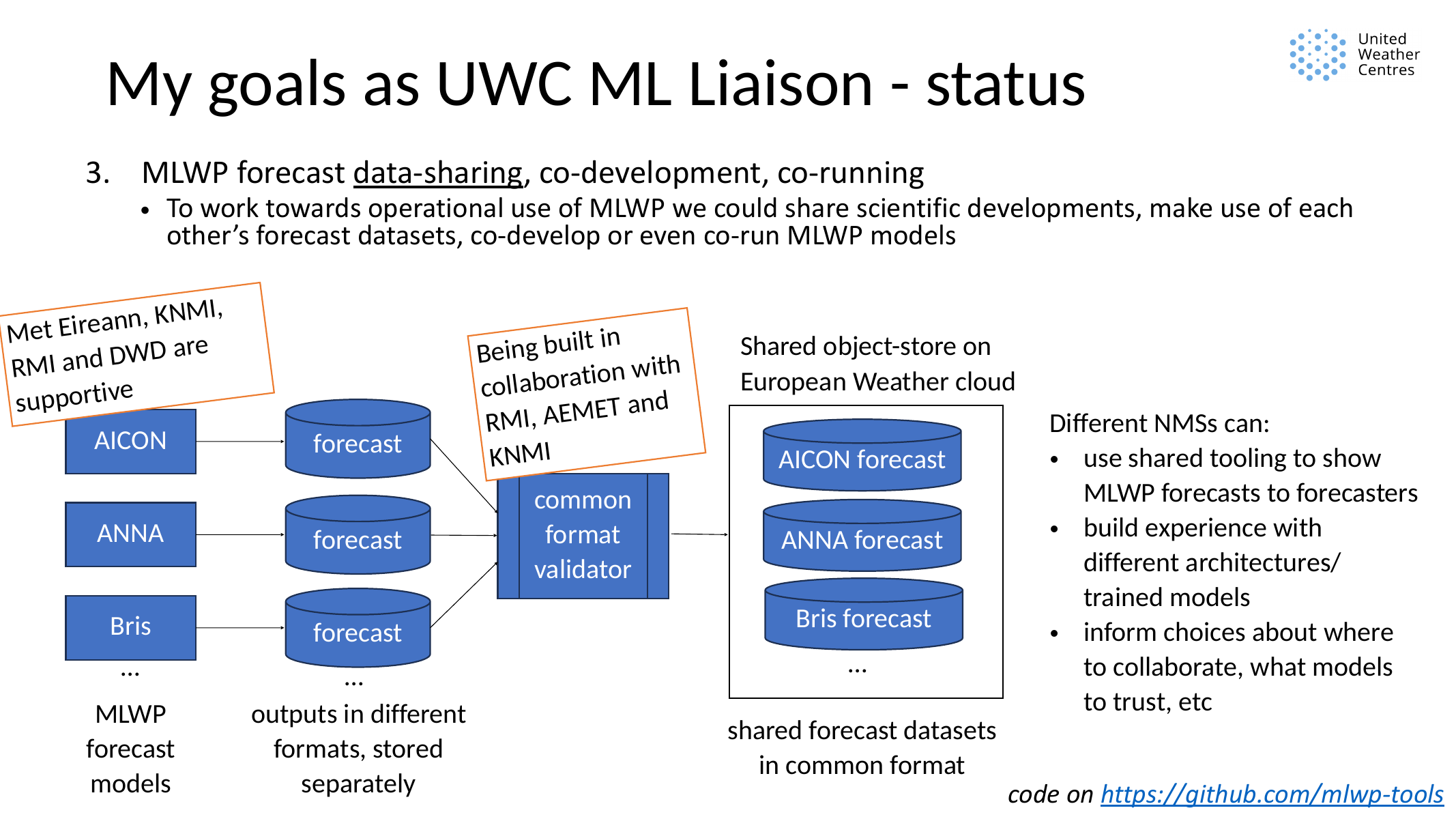
This would let different centres build experience with different architectures and trained models, compare them more systematically, and make better decisions about where to invest in further development. This tooling is already being developed with partners at RMI, KNMI, DMI and AEMET, and I will be sharing more about that in a future blog post.
This work also includes scientific community-building. I am especially interested in MLWP from a physical and numerical modelling perspective: what processes are represented, which variables matter, which architectures help, and where the models break.
That is the kind of question I think MLWP needs more of.
What This Blog Is For
My intention is that this blog will be a public synthesis of my ML liaison work.
It will include project updates, technical reflections, summaries of public work, and open questions for the community. It will not be a public archive of private meeting notes, personal correspondence, institutional positions, or unconfirmed commitments.
The intended audience is people working on MLWP in meteorological services and nearby research communities: UWC first, but also E-AI, ACCORD, WMO-related efforts, and the wider weather and machine-learning community.
What I Hope This Enables
My working hypothesis is that the choices we make now about datasets, modelling code, forecast outputs, verification tools, and downstream uses will shape what MLWP can become operationally.
If we build on existing standards and the scientific Python ecosystem, keep the systems open enough for experimentation, and design around shared use rather than isolated demos, we improve the chance that today’s work becomes robust operational infrastructure rather than a collection of disconnected prototypes.
And if we let physics-based scientific research guide model development and evaluation, we improve the chance that MLWP becomes not only skilful, but also understandable and trustworthy.
Likely Follow-Up Posts
This first post is only a starting point. Some topics I expect to return to are:
- Announcing the Physical-Process MLWP Seminar Series: why I think the MLWP community needs a forum that has a physical processes focussed approach to weather forecasting with machine learning, and the talks I have planned in that.
- Towards common verification tooling for MLWP: why shared data structures, common verification workflows, and reusable diagnostics matter if different centres are to compare models reliably.
- Data formats are part of the science: why choices about Zarr, CF conventions, validators, and shared forecast stores shape what scientific and operational questions we can ask.
- The current software ecosystem for ML weather forecasting: a map of the models, datasets, tooling, frameworks, and infrastructure emerging around MLWP, and what that ecosystem makes easier or harder for meteorological services.
- What should a km-scale MLWP benchmark test? how to move beyond generic scores towards operationally relevant evaluation of extremes, spatial structure, physical consistency, and forecast usefulness.
- Why physical-process verification matters for MLWP: what it means to ask whether a model represents convection, precipitation, clouds, balance, or uncertainty in a physically meaningful way.
- What I am learning from UWC/NMHS conversations: synthesis from discussions across meteorological services, shared only where it can be done without exposing private meeting notes or institutional positions.
Suggestions are welcome: papers, datasets, verification methods, physical- process studies, seminar speakers, or collaboration ideas. See the Contact page or put in a comment below! 😊